Latest Solidarity Issue

Dues

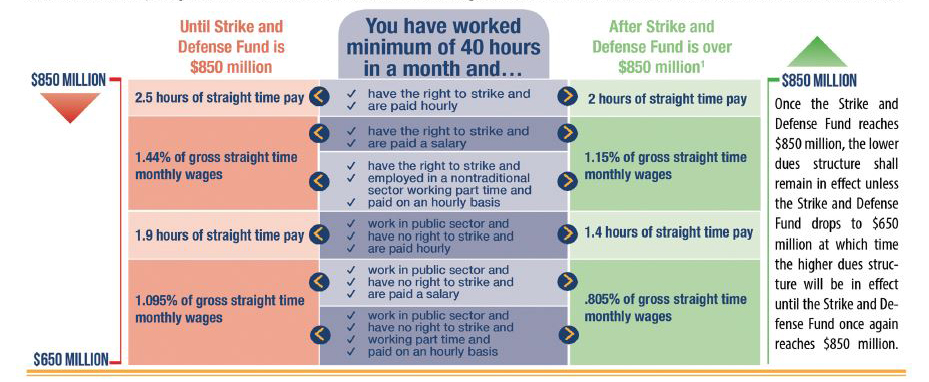
UAW members pay monthly dues equal to two hours pay or, for salaried workers, 1.15% of their monthly salary. Public employees who are prohibited by law from striking are not required to pay into the UAW Strike Fund, so they could pay proportionally lower dues.

The UAW's current dues structure was established by the delegates to the 1967 Special Convention. In restructuring the UAW's dues program, the delegates had two basic objectives. First, they wanted a dues structure that would be fair to all UAW members regardless of their annual incomes. Second, they were determined to provide for the long-term financial health of UAW locals and the International Union with a dues structure that wouldn't have to be changed every few years. Their solution--linking dues to earnings--satisfied both objectives.

How UAW Dues Are Used

Under the UAW Constitution, a member's dues are divided among three UAW funds:

  • 38% stays in the local union.
  • 32% goes into the International Union's General Fund.
  • 30% goes into the UAW Strike Fund. However, if the balance in the strike fund exceeds $500 million, the rebates described above apply.


In the UAW, Members Set and Control Dues

UAW members determine dues in the UAW. That's because the UAW is a membership organization. The current UAW dues formula-two hours pay a month-was set by local union members at a UAW convention in 1967. These delegates had been elected by UAW local unions across the U.S., Puerto Rico and Canada.

That dues formula remains in effect to this day. In fact, it has proven to be so fair and acceptable that many other major unions have adopted the UAW system. Our dues are tied to our straight time hourly earnings, including negotiated profit sharing and bonuses, but not overtime pay.

Both hourly and salaried members pay 1.15% of their monthly income-equivalent to two hours pay. Public employees who do not have the legal right to strike are not obligated to pay into the UAW strike fund.


Linking Dues to Success at the Bargaining Table Works for Everyone

The UAW's system of linking dues increases to pay increases has worked well for UAW members. In 1970 a typical auto assembler earned $7,904 a year and paid $91 a year in union dues.

By 2000 that assembler's basic annual pay (based on 2080 hours a year) was $47,798 while dues had risen to $552.

That member is paying $461 more in dues while union-won wage increases have put $39,894 back in this worker's pocket. That's an $87 return for every $1 dues investment. If you included negotiated benefits, job security, human dignity and decent working conditions, the return on investment would be even greater.

What about UAW members who don't work for the auto companies?

They have benefitted from the same dues formula in exactly the same proportion.

By linking dues to pay increases, the UAW has insured that the strongest possible efforts will be made at the bargaining table to win good pay packages.

But if wages don't go up, then dues don't either.


It Doesn't Cost to Belong to the UAW, It Pays

The paycheck rewards for belonging to a union are well known. Even after dues are deducted, UAW members bring home far more money than most nonunion workers.

Where we have the bargaining strength and the employers have been financially able, we have negotiated some of the best pensions in America and the premier health care plans in the country.

Even with employers who can't afford top-of-the-line benefits, UAW negotiators have won pay and benefits far in excess of what workers would have received without a union.

But belonging to a union brings rewards greater than bigger paychecks and better benefits.

Union members have the dignity of collective bargaining.

In nonunion operations, workers have little voice in determining much of anything affecting their work. Nonunion employers have the right to arbitrarily change or end their health insurance, pension plans or any other benefit without negotiating with their employees. Work rules can be changed at the employer's whim.

Company handbooks are carefully written to give employers nearly complete control.

But with a negotiated, union contract, workers have real input into the terms and conditions of their employment: everything from wages, hours, safety, pensions, job advancement. Actually the process of negotiation can force management to end inconsistencies, develop fair rules that apply to everyone, and structure benefits in the best way possible.

One page in a contract is worth a thousand promises.

When you are part of the UAW, the personnel office must share its power with you.

We UAW members get a great sense of accomplishment from working together, standing up together, and addressing our common problems in the workplace and the community.


UAW Dues at Work

UAW dues work for you in many ways. The UAW Constitution explains how your dues are normally divided with 38% staying in the local union, 30% going to the strike fund, and 32% going to the International Union. As long as the strike fund remains over $500 million, locals get a rebate from the strike fund that brings their share to 48% and the International gets a rebate that brings its share to 37%. If the strike fund should drop below $500 million, the rebates would end until the strike fund was rebuilt to $550 million. In late 2000 the UAW strike fund was about $800 million.


UAW Local Unions are on the Front Line with You

The largest share of your dues dollar remains in your local union where it plays a vital role in protecting your rights.

The UAW has 1,064 local unions around the country ranging in size from less than a hundred members to locals with over 15,000 members.

Our locals are centers of creative energy and enthusiastic participation.

The first job of local unions is to help negotiate and enforce our contracts.

But UAW locals do much more.

Many locals have committees committed to organizing new groups of workers. The most active members help in boycott efforts or on picket lines of other unions.

Local union meetings are like old-fashioned town hall meetings where every member has a right to stand on the floor and be heard. It's real participatory democracy that seems to be lost in too much of America.

Today many locals are using computers, video programs, informative newspapers, and top-of-the-line educational programs to keep members informed.


Our International Union Knows How to Bargain

The International Union has blazed the trail for American workers for over 60 years. The bargaining accomplishments of the UAW are a matter of record. We've negotiated pensions, health insurance, job security, health and safety standards, fair work procedures, joint quality programs, and many other innovations.

Yet this hasn't happened by accident.

It's taken unity and solidarity and courage of UAW members.

But it's also required dedicated International leaders and regional directors.

UAW international representatives are skilled, well-informed, and dedicated to our interests. They work with our local union leadership. And they are backed by a top notch staff of professionals: lawyers, actuaries, financial analysts, and other experts.

UAW lawyers have fought for us all the way to the Supreme Court -- and have won.

Our pension experts have helped design some of the most innovative pensions in the country, and they've fought to improve and protect our pensions despite corporate mergers, buyouts, and other maneuvers.

Our health and safety department inspects workplaces, educates local health and safety teams, and fights for federal standards to protect us.

A union's bargaining strength depends on organizing new members.

We educate our members and communities about the goals and accomplishments of unions.

And we work to make sure that political changes help -- not hurt --workers and our families.

We publish Solidarity magazine with its lively letters-to-the editor pages and reports on the issues and activities that matter to us.

We fight in every arena -- at the bargaining table, in Congress and state legislatures, in the courts, and in community organizations -- to protect our rights to a job, decent retirement, and safe workplace.


Our Strike Assistance Program Backs Us Up in Negotiations

For many years the UAW has maintained the largest strike fund of any union in the country. We believe UAW members must always be protected financially if they decide they have no choice but to strike.

Today UAW strike benefits are $175* a week plus medical-hospital and life insurance coverage.

Some unions do not maintain strike funds. But a strong strike assistance program is important in convincing employers that we are willing and able to strike. Often just being prepared to strike is the best way to avoid a strike.

Because we are prepared, very few UAW negotiations end in a strike.

*$200 a week effective August 1, 2002

A Healthy Strike Fund Is Often 
the Best Way to Avoid a Strike


Our Family Education Center is Open to All UAW Members

The Walter and May Reuther UAW Family Education Center is located on Black Lake near Onaway, Michigan. It is funded from interest on the UAW strike fund. No union anywhere in the world offers an education center of this magnitude to its members. With its stunning design, beautiful location, and warm, open atmosphere it is the envy of labor educators.

Each summer UAW families may apply to participate in the scholarship program. Members, spouses and older children learn about the union and have the opportunity to participate in supervised recreational programs.

The education center also conducts conferences geared to the responsibilities of union officeholders. Classes are offered on leadership development, union involvement, health and safety, political action, civil rights, and many other topics.

The center is also used by UAW regions for leadership training in their summer and fall schools.